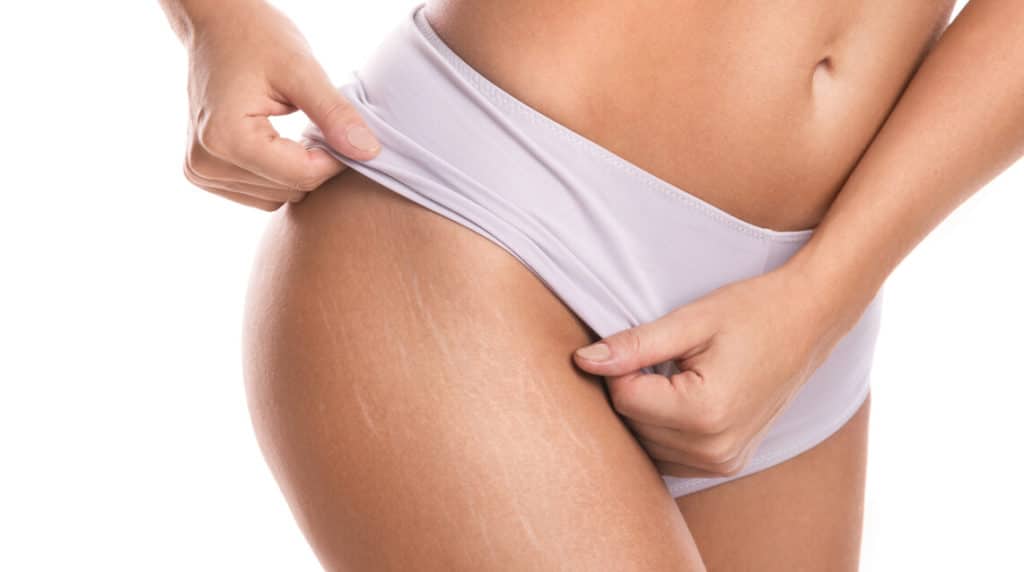

Stretch marks are scars that appear when the skin is put under stress. This may be during pregnancy, a result of weight gain, or even rapid muscle gain from bodybuilding. Like many scars, they can make people self-conscious and hesitant to let others see them in certain clothes. With Opus™ Plasma, though, you can see stretch marks fade or disappear.
The name “striae gravidarum” means “pregnancy scars”, and the changes that occur to a woman’s body during pregnancy are one of the most common causes of stretch marks. These often appear on the abdomen but can also appear on the breasts during breastfeeding.
These scars can appear any time the skin is stretched, especially if the stretching happens relatively fast. Weight gain, another common cause of stretch marks, can leave these scars on the abdomen, chest, thighs, and arms. Not everyone develops stretch marks in the same places, and some people do not develop them at all. Genetics can play a role in stretch mark development but they can also form as a result of weight gain, bloating, pregnancy, and many other reasons.
Opus™ Plasma uses high-frequency unipolar radiofrequency technology to penetrate the skin with tiny microchannels. The combination of radiofrequency and microplasma energy works more effectively than lasers or microneedling.
The microdamage to the skin breaks up scar tissue that makes up striae gravidarum. It then triggers a flood of healing factors to the area, followed by an increase in normal, healthy collagen production that replaces some of the scar tissue.
With several treatments, you may see stretch marks fade to almost unnoticeable or even disappear completely. Stretch marks vary in color, thickness, and texture, so each person’s are unique and results can vary.
If you have striae gravidarum on your abdomen, sides, arms, legs, or any other parts of your body, you may be a good candidate for stretch mark treatment. The Opus™ Plasma can be easily adjusted for even delicate or sensitive skin. Unlike many lasers, it treats all skin tones and types.
The Opus™ Plasma minimizes downtime. The treated area may be red, sensitive, or swollen, but this should go away within 24-48 hours. You can resume normal activities, but make sure to protect your skin from sunlight as it heals.
You can expect to see your stretch marks feel softer and smoother. They will begin to look more like the surrounding normal skin. These results begin after the first treatment, but most people need two to three treatments for full results.
Over time, the scar tissue in your stretch marks continues to soften, and with each treatment, more healthy collagen replaces the rougher scar tissue. The healing factors that respond to the microdamage promote normal, smooth skin to grow in place of the stretch marks.
The name “striae gravidarum” means “pregnancy scars”, and the changes that occur to a woman’s body during pregnancy are one of the most common causes of stretch marks. These often appear on the abdomen but can also appear on the breasts during breastfeeding.
These scars can appear any time the skin is stretched, especially if the stretching happens relatively fast. Weight gain, another common cause of stretch marks, can leave these scars on the abdomen, chest, thighs, and arms. Not everyone develops stretch marks in the same places, and some people do not develop them at all. Genetics can play a role in stretch mark development but they can also form as a result of weight gain, bloating, pregnancy, and many other reasons.
Opus™ Plasma uses high-frequency unipolar radiofrequency technology to penetrate the skin with tiny microchannels. The combination of radiofrequency and microplasma energy works more effectively than lasers or microneedling.
The microdamage to the skin breaks up scar tissue that makes up striae gravidarum. It then triggers a flood of healing factors to the area, followed by an increase in normal, healthy collagen production that replaces some of the scar tissue.
With several treatments, you may see stretch marks fade to almost unnoticeable or even disappear completely. Stretch marks vary in color, thickness, and texture, so each person’s are unique and results can vary.
If you have striae gravidarum on your abdomen, sides, arms, legs, or any other parts of your body, you may be a good candidate for stretch mark treatment. The Opus™ Plasma can be easily adjusted for even delicate or sensitive skin. Unlike many lasers, it treats all skin tones and types.
The Opus™ Plasma minimizes downtime. The treated area may be red, sensitive, or swollen, but this should go away within 24-48 hours. You can resume normal activities, but make sure to protect your skin from sunlight as it heals.
You can expect to see your stretch marks feel softer and smoother. They will begin to look more like the surrounding normal skin. These results begin after the first treatment, but most people need two to three treatments for full results.
Over time, the scar tissue in your stretch marks continues to soften, and with each treatment, more healthy collagen replaces the rougher scar tissue. The healing factors that respond to the microdamage promote normal, smooth skin to grow in place of the stretch marks.
If you would like to learn more about how to treat stretch marks, please call our office at 505-848-8346 today to schedule a consultation or fill out the form on this page and one of our trusted staff members will reach out to you promptly.